10 things we should know about each other: Academics & Humanitarians
September 2021
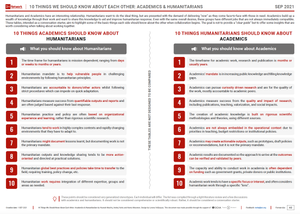
AI generated summaryThis report examines the complex relationship between academics and humanitarian practitioners, highlighting how these two groups can better collaborate to improve aid responses. While both groups share a desire to help those in need, they operate with fundamentally different mandates, timeframes, and institutional constraints that often make their working methods incompatible. By identifying these core operational differences—such as the humanitarian focus on immediate, action-oriented delivery versus the academic emphasis on rigorous, peer-reviewed scientific methodology—the document provides a foundational framework for more effective partnerships. Rather than acting as a prescriptive guide, this resource serves as a vital conversation starter for professionals looking to bridge the gap between research and field practice. It offers synthesized insights into the distinct motivations and accountabilities of each field, ranging from humanitarian organizational learning to academic curiosity-driven research. Understanding these contrasting lenses is a critical first step for any collaborative effort aimed at integrating different expertise to achieve more impactful outcomes in complex, rapidly changing environments. The insights presented are intended to foster mutual understanding and streamline the process of knowledge sharing between the academic and humanitarian sectors. By acknowledging that these points are generalizations rather than rigid rules, teams can navigate the inherent tensions in their working relationships more effectively. This resource encourages stakeholders to engage in open dialogue, helping to align academic rigor with humanitarian urgency to ultimately improve the effectiveness of humanitarian interventions. |